Friday, July 26, 2013

The Highest Guys in California: Taking The Mountaineer’s Route Up Mount Whitney


Lonely At The Top: The Whitney Summit

    A pair of headlights sweeping through the desert night.
    It was around 10 p.m. down in Badwater Basin, but when I touched my fingers to the passenger-side window, I could still feel the tremendous heat outside — throbbing off the rocks, the salt flats, the hills.    This was Death Valley, California.
    The bottom of the basin reaches 285 feet below sea level, making it the lowest point in the United States. It also has the highest recorded temperature for the nation, some argue for the world. Though the Valley is an impressive place, it was not the end goal for Andrew and me. That goal lay 80-some odd miles to the west to Mount Whitney, the tallest mountain in the contiguous United States at 14,500 feet.

    Suddenly, a beige form slunk out from behind some sagebrush. Andrew slammed the brakes just in time to avoid flattening a coyote. The phantom animal faded back into the dark and we drove on.  When we finally reached the turnoff for the hike, we were the only car in the lot. A balmy wind greeted us as we stepped out and walked down the wooden steps to the lowest point in North America.
    It was impossible to make out the entire sweep of the landscape, only the small zone of illumination within my headlamp beam. The light did reveal brittle salt ridges. I bent down with a wet finger and tasted the brine, which had traveled along miles of water courses that ended not in the sea but in this great evaporating pan, where the liquid surrendered to the atmosphere.
    We walked out a ways and looked out over the far reaches of the flat plain. This was good enough. Soon enough we were back in the car, heading west and gaining elevation. We slept in the foothills of the Sierras, 4,000 feet above sea-level, beneath a blanket of stars.

Starting Out In Sleet
    Sixteen hours later, Andrew and I were at 8,000 feet sitting at parking lot to the Mount Whitney trailhead. A windblown torrent of sleet slapped at the windshield; neither of us were eager to get out of the car to begin packing our stuff again. The storm had come right as we were getting organized and I had hastily thrown a tarp over my clothes to keep them dry. It seemed clever at the time, but as I sat in the car, I realized that it was probably inadequate protection. Sure enough, I went outside to find that the water running down the asphalt had gotten underneath the plastic and soaked through my warm mittens.
    Eventually, the slushy flakes subsided enough so that we were willing to step outside. We finished packing our stuff and started up the trail. May was still early in the season for Whitney climbers so there wasn’t much company.
    We had opted to take the Mountaineer’s Route up the mountain instead of the more popular Mount Whitney Trail. Our campsite would be at Upper Boyscout Lake, at the edge of tree line, which would help us acclimate and prepare for a tough push to the summit the next day.
    The Mountaineer's Route would be shorter, but it would also be steeper and more technical. Both of us had crampons and one ice axe apiece, which we would use to hack our way to the summit. We would also have to blaze our own trail for the final section of the climb, which is why I had brought a compass and a topographic map.
    The hike started easily enough with a crushed gravel path leading up through the towering sequoia stands which were some of the tallest trees I’d ever seen. A neat series of switchbacks tamed the ruggedness of the mountain for us. 
    The cold white clouds hung low over our heads, concealing Whitney and its neighboring peaks. Every now and then, the wind would shift them slightly, enough so that we would get a glimpse through to the snowy realms above.
    After about a mile, we reached the place where the Mountaineer’s Route split off from the main path. A sign warned us that the route was not for the novice hiker and even someone who had reached the top via the Mount Whitney Trail before might not be prepared for the challenge of the Mountaineer’s Route. The mountain would punish the overconfident, it said.

Sequoias and snow seen near Lower Boy Scout Lake on Hike Down 

    Sure enough, the new path proved harder. There were slippery boulders to scramble and close brush on either side of the trail that slapped us with freezing droplets. Sometimes we lost the trail and had to stumble through the wet vegetation to find our way again. We crossed and re-crossed the stream running down the center of the valley, then started a steep climb next to the edge of a cliff. We grasped at slick handholds and wriggled worm-like up six-foot ledges as the valley dropped away into foggy gloom.
    The snow started up again by the time we reached Lower Boy Scout Lake, so I put the snow pants back on and then my rain jacket over my parka. A man and a woman were making their way back down. They decided they didn’t have the gear to make the climb in this weather.
    It was maybe two more miles until we reached Upper Boyscout Lake at 11,500 feet. Deep snow drifts waited on the way between, followed by a series of cairns leading up a stream. The daylight was almost faded by the time we got there and the temperature was dropping fast.
    We pitched tent amidst the boulders near the lakeshore. There weren’t any good places to set up stakes, or trees to tie off to, so I pinched the tent walls down with heavy rocks. Lord knew we needed them in the high wind. Andrew spent a few minutes looking for a sheltered spot for dinner and found a tiny alcove beneath one of the larger boulders. It was just enough protection against the whipping flakes so that we could light the stove and enjoy some dehydrated potatoes and cheese, spooning it up quickly with frozen hands.
    Afterwards, we clambered into the tent, into our sleeping bags and rest for the summit push on the next day.

Camp at Upper Boy Scout Lake
    We got up at around 5:30 in the morning and cooked up a monster batch of oatmeal before we started up the trail.
    There were snowshoe tracks through the powder, a big help considering how difficult it was to spot the cairns that marked the way. After about an hour of hiking we found the two hikers who had made the tracks. The two were breathing hard. They had come from Arizona and spent one day at 7,000 feet before climbing to Upper Boy Scout Lake. They still hadn't acclimatized to the thin air.
    “I can feel my heart beating in my eyeballs,” one of them told me.
My heart was not beating in my eyeballs, but I did feel that I was working harder than normal to catch my breath, trudging through the snow, sometimes falling in thigh-deep.

    There were no more tracks after we passed the Arizonans. It was up to us to navigate the snowy boulders ourselves on what we thought was the trail. We had a couple of false starts and plenty of doubt, but eventually we reached Iceberg Lake. The summit of Whitney was still out of sight, lost in the clouds
    Now things would get interesting. We were at 12,500 feet with 2,000 more feet to climb to reach the summit. To get there, we would have to ascend one of several couloirs — the steep, snow-filled ditches— in between the even-steeper rock faces. The question of which couloir we should climb was harder to determine, especially since the summit was out of sight. I spent some time squinting at my map and compass before I decided on a route that lay on the far side of the lake. It wasn’t exactly where I thought it would be based on the map, but the other climbs seemed too steep.
We ate some lunch before we started. Soon enough, the Arizonans trudged in. They told us that the correct route was further to the left. It was steep, but that was what we brought the axes and crampons for.
    They started up the ascent themselves, becoming small and dimmer as they reached the edge of the clouds. Andrew and I put our crampons on and followed.

Iceberg Lake
    The way was steep, but not quite as steep as it had looked from the lakeshore. The difficult part was trudging up the knee-deep powder, and all the loose stone underfoot. Each footstep would roll some of these rocks and dislodge a bit of snow. We leaned in on our axes for support, panting in the thin atmosphere.
    After a couple hundred feet of climbing, we passed the Arizonans, who were moving at a glacial pace now. Things got steeper as we entered the couloir and a cold wind gusted down between the stone walls, throwing the chill air into our faces. I was more than warm with effort.
    The walls on either side of us and the clouds blocking the view up above, reinforced a sense of tunnel vision. There was little on my mind beside the dumb effort of lifting my feet up, trudging toward the unseen goal. The altitude made me feel a little stupider, a little clumsier, a little weaker. Now and then I would stumble on the lose rock and fall a couple steps backward. I found myself stopping often with my heart racing, resting my weight atop my axe.
    By the time we reached the top of the couloir, Andrew and I were both exhausted. There was still perhaps 800 more feet to the top, which was still invisible in the clouds. We were out of the steep couloir but there were plenty of large boulders to navigate around, as well as some steep rock faces up above that we probably didn’t want to climb. Finding the summit would require a bit of compass navigation combined with some educated guesswork. We opted to take a traverse instead of going straight up, a choice that found us going over some sketchy snow crossings where a misstep could have meant a long tumble.

Ascending The Couloir
    We were a couple of hundred feet from the top of a ridge and already at our designated turnaround time. The snow, which had taken a brief respite when we topped out of the couloir, began to fall with renewed vigor.
    “Either this is it, or were not going to make it,” I told Andrew.
When I finally reached the top of the ridge, I found a set of footsteps in the snow. It could only have been someone hiking along the Mount Whitney Trail. I felt a combination of relief and satisfaction. The summit couldn’t be far from here.
    Sure enough, the summit hut emerged from the whirling flakes about a quarter-mile later. The boulder pile nearby marked the top of the mountain. There wasn’t much of a view for us to see through the snow, but who cared? We were the highest guys in California! We were also the highest guys in 48 other states, all except Alaska.
Ice Axe Dance At The Top
    Unfortunately, there wasn’t too much time to savor the moment. We made a quick stop at the summit building to sign the log, then wound back down through the boulders to the culoir. It was slow, tricky business to avoid slipping on the rocks. I ended up skidding multiple times on the way down to Iceberg Lake despite my careful steps. It looked like the Arizonans had decided to turn around much earlier, and we never saw them again.
    We reached my tent by late afternoon and decided that we could hike the rest of the way to the trailhead before it got dark out. We’d had our fun up there and now it was time to get low again.
    The clouds were breaking up overhead, revealing the blue sky. The snowy peaks blazed in the last light of the day. Below the snow lay the green band of giant sequoias, drinking up the meltwater, hanging on in that perilous zone between tundra overhead and desert below. The rain shadow cast by the High Sierra made for the dry hot mountains to the east, Death Valley too. One climate fed into the other, required the other. Each offered its own mysteries and fascination to me as I looked down upon the multifaceted landscape.
    It was all there.


Tuesday, July 23, 2013

By Rope And By Swim: Descent of Subway Canyon


The author, helmeted, strikes a defiant pose in the middle of Subway Canyon
They had dry bags. We had garbage bags. They had wetsuits. We had rain jackets and fleeces.
The two brothers Andrew and I met in the parking lot looked a lot better prepared to go through the freezing pools of Subway Canyon than we did.
Hypothermia is not the first thing that comes to mind when most people think about Zion National Park in the southwest corner of Utah. More likely they think about the park’s desert landscape, the bleak edifices of stone baking in the sun. But there is cold there too. When we visited in May, the park still held snow patches in its 8,000-foot highlands. The meltwater inevitably channeled down the drainage into the canyon where Andrew and I planned to go, and would force us to wade or swim to get through. We wrapped our clothes in not one, but two garbage bags to keep them dry (the bags reeked with an industrial-sweet odor.) Hopefully, everything would be dry when we needed it to be.
Subway doesn’t just have cold swim sections, it also required that we bring rope for a couple of rappels off cliffs. The swimming and rappelling would make for a fun obstacle course provided that we didn’t freeze to death before we made it through.
Both the guidebook and the park ranger at the visitor’s center recommended wetsuits for anyone going through in the spring. The ranger didn’t stop us though. We might be in for a rough time, he told us, though he didn't think we were going to die.

We left Andrew’s car at the end of the canyon and then hitched our way toward the Wildcat Trailhead where our journey would begin.
We were about to start down the trail, when a rental car pulled into the parking lot behind us.
Two guys jumped out: brothers. Both looked very fit, had sun hats, high-performance outer-ware, and no shortage of confidence.
“Hey, are you doing The Subway,” one of them shouted.
“Yeah,” Andrew said.
“Oh cool,” the guy said. “Would you guys mind if we came with you?” It was almost a question.
He made his case quickly. They had food, water, rope and wetsuits. They had both tried to find the entrance to the canyon the day before, but had gotten mixed up on the directions and ended up wandering through the trees all day. Now they wanted another set of eyes to help them find their way, oh and a ride back to the trailhead too. We had a guidebook with us, so that put us a little ahead of the game.
The brothers offered to let us keep the rope Andrew was carrying in their car so that we can lighten the load.
Once we started down the canyon with one rope, we would have to stick together. I had some trepidation about this but we went with it.
Meanwhile, daylight was burning, so we saved the getting to know you stuff for the hike. As we scrambled down the trail, I learned that the brothers were from Manhattan, where they worked in radiology. When they weren’t scoring girls or hitting clubs they liked to go on adventures — places like Columbia, Central America and Rio where they went diving and explored caves. While Andrew and I were spending a month of tenting for free in National Forests and eating out of cans, these guys moved fast, flying into Vegas, getting the rental and staying in hotels. They’d also found a place that rented wetsuits, which was something Andrew and I might have considered.
Though I worried about the cold ahead of us, it was hard to imagine that while we were under the hot desert sun. Juniper and Pinyon pine trees grew out of the dry, rocky soil  and our footsteps sent up clouds of dust.
When I stopped to take a leak, a whiptail lizard raced out from behind a rock to drink from the warm stream. It skitted away just as quickly. Maybe the flavor wasn’t to its liking or maybe the towering biped that the liquid came from scared it off.
We stopped several times along the way to double check directions. It was easy to see how the brothers had become confused the day before. Eventually, we made it to an overlook where there was a steep, crumbly descent to the canyon bottom.
The creek was down there. It wasn’t a large flow of water, but in time, it had succeeded in carving through hundreds of feet of stone. The waters were dark, shaded by the canyon walls.

The first crossing
We took a rest by the edge of a murky pool. There was no way around so we would wade. One of the brothers offered me a bag full of watermelon slices.
“Here take some.”
I turned it down, perhaps unconvincingly.
“C’mon. It’s really good. I brought too much of it and it will go to waste.”
I grabbed a slice and savored the sugary liquid. It was good.
I turned toward the pool, steeling myself for the cold temperatures.
“Hey. You want to borrow my wetsuit top?” The brother extended the neoprene garment.
“Nah, I should be good,” I told him, thinking about all the pushups and profanity I would use to get warm on the  other side.
“Go ahead. Put in on. The wetsuit pants should be good enough for me.” I relented and put the top over. It was one of many shows of generosity that the brothers showed throughout the day, including sharing more food and inviting us to chill out at their hotel later on. By the time we finished the hike, one of the brothers was unsatisfied with the fit of his trail running shoes and told me I could have them. I took him up on the offer and they ended up being useful on several future hikes.
After I put the wetsuit on, I threw my rain jacket over it for an additional layer of warmth, took a breath and stepped in.
A knife of cold went up my leg as soon as it went through the water. I might as well have gone wading in a slushy. I kept moving forward: knee-deep, crotch-deep — yikes! At belly-depth, the water started getting shallower again
 I was good and cold when I reached the other side, watched as the brothers crossed, looking like Navy SEALs in the wetsuits and panama hats. We started moving again, warming our numbed legs with exercise. After a while, I felt the warmth come back and even started to appreciate the scenery of the canyon walls. Not long after, we came to a spot where a boulder all but a narrow passage in the canyon. Beyond that passage, there was our first rappel. It was only about 12 feet or so, but went past an overhang with a waterfall pounding next to us. We took our time going down the rope and landed in the water at the bottom. One of the brothers had forgotten his belay device and had to move down the rope barehanded.
Now I had a good chill going. It didn’t help that we might occasionally have to put a foot down into ankle-deep water to navigate the cobbles on the canyon bottom.
The big challenge was yet to come however. Suddenly the canyon narrowed abruptly between smooth stone walls, forming a narrow passage of deep water. Then the floor dropped away and there was a waterfall. There was no way around, no choice but to plunge on through. Fortunately there was an alcove with a ledge about halfway through the passage, a place to try and get warm before taking on the waterfall.
Another place to get cold
T
hat first section was predictably hellish. The water got to chest deep and we thrashed our way through as quickly as possible. I clenched my jaw so hard that it ached. When we got to the alcove, Andrew and I tried to fight the cold with plyometric exercises. It helped some, but I was nowhere close to being warm.
Someone had laid a bolt for a rappel over the waterfall but we didn’t use it, opting jump down into the deep pool instead.
To do this, we would have to launch our packs over the edge first.
When my turn came, I was still shivering, dreading what would come next. I stepped up to the brink of the ledge and looked down into the wine-dark pool.
I chucked the pack, watched it float half-submerged away from the falls. I jumped after it. There was the feeling of being airborne, the plunge, the rush of water about my ears. Then it was stinging cold all over my body. I started swimming as soon as I popped to the surface, thrashing for the other bank. By the time that I had covered the 20-foot distance, I was dazed with cold, numb all over.
I saw Andrew run up to the other side of a river bank where a patch of sunlight shone down over the canyon walls. It looked like a good place to be, so I ran over there too. I stared up to the sun with eyes closed and extended my arms on either side so that I could receive the maximum solar output. No doubt, I looked like a supplicant in some ancient temple. It made sense to worship the sun. Right now, it was bringing me back to life.
The group of us took a long time here, replenishing ourselves with food and sunlight. A group of men and women came past us with go pro-helmets, talking in an Eastern European language. We would see them again not far down the canyon as we came to the final rappel.
No jumping this time. We had a good 20-foot rappel down another canyon wall into shallow water. We waited for the Europeans to descend their rope. Some of them had not done much of this before, and there was one young woman in the group who hesitated a long time before finally going over the edge.
“Ho! Ho! look at that!”
I looked. The two brothers were gathered at the edge pointing downward. Fortunately the woman on belay was too terrified at the descent to notice the brothers leering down her blouse.
At last, the Europeans moved on, and we were free to use the belay. I lowered myself to one shelf and then started kicking my way down the wall.

The final descent
Suddenly everything slipped. I felt a sting in my hand and jerked to a stop. I looked and realized that I was caught in the belay device. Either the rope slipped or I slipped up. Either was possible considering the rope may have been slick and because I’m still a novice at this stuff.
The pain hurt like hell, and I remembered a past climbing instructor telling everyone that once you make the mistake of letting your hand get too close to a belay device you are unlikely to repeat it.
I realized that I would need to yank my skin out from the belay device if I was going to reach the bottom. I gritted my teeth and jerked my hand. It broke free and I escaped with skin attached. I made it the rest of the way down to the pool unscathed. There was an ugly welt on my hand as an accusation of carelessness. The pain was one thing, but the possibility that I made such an amateur mistake rankled \ worse.
Everyone went over what might have gone wrong when we reached the bottom. There were no more technical challenges ahead of us, but there was plenty of hiking to do. I was eager to keep moving.

Walking down the river

In the miles ahead we took our time to enjoy the scenery of the canyon. The water got warmer too and we even ended up taking a dip voluntarily. The trail through the canyon was as beautiful as it was isolated and it was hard not to get taken up with the majesty of the high canyon walls, especially as the sun got lower in the sky.
I could see the brothers were enjoying it especially. Somehow, amidst all the Manhattan parties that they went to, living as big spenders, I got the sense that sharing these trips as brothers was more important to them than any of it. It was an escape from city pressures, their stressful jobs in radiology where they saw patients get bad news every day.
When they finished the canyon, the two of them would have another day to check out nearby Bryce Canyon and then they would have to drive back to Vegas, fly back to New York and where their jobs were waiting for them. Andrew and I would also drive toward Vegas, but we would keep going west, stop at the Red Rocks Canyon Nation Conservation Area to climb around and then proceed toward Death Valley and Mount Whitney.
For sure, Andrew and I came with a different style than the brothers, but I was glad that we ran into them. One way or another, I hope that we can all continue to have our adventures, along the paths we choose.

Tuesday, July 9, 2013

Leaving a Mark


When the ancient inhabitants of Horseshoe Canyon first began to decorate the redrock walls with images millennia ago, I wonder if anyone told them that they were wasting their time.
The time and energy needed to grind pigments, or to carve outlines into the desert varnish with a stone must have been a serious commitment considering that there would have been animals to hunt and crops that demanded cultivation. Whatever lives that the early people were able to build for themselves in that canyon could have been uncertain, under threat from a surprise drought or an act of aggression from neighbors. Nonetheless, the ancient artists continued to chip and paint the rock, leaving images of people, animals and spirits.
When I looked at those images on a hike through that canyon in the Utah desert thousands of years later, the stone left me with more questions about the people who marked it than they answered.
Clearly, animals were important to those people. Representation of game animals may have been a way that they tried to ensure a successful hunt in the future, or a way to document past triumphs.
Without a written language, the people within the canyon were limited in the level of detail that they could convey. They would have to make the pigments and brushes. They would have to re-imagine what the animals looked like and be responsible for creating their own arrangements that worked with the space that they had. 
Contrast that to our current, connected world where anything can be typed out, digitized, uploaded and made accessible to everyone. The only barrier between the thought and the creation is the time it takes to tap the touch screen a few times — trap the image with the camera and then post it.
Making paint or carving out an idea in the desert rock was much slower work that would require commitment. No doubt, those early artists would choose their panels carefully and think hard about what they wanted to depict.
Even with those efforts to express themselves, we are far removed from any complete understanding of those panels now. We can only take guesses about what the artists had intended. Should it be any different after we have spent our time on earth? What will all our Facebook posts, internet memes, videos and blogs tell future generations? No doubt, they will fade into obscurity as well, though I doubt I am making headlines for saying it.
I can only imagine that in their time, those ancient wall posts must have sparked pride in a people, perhaps a sense of identity. If even a small portion of the artists’ intentions had come across to me as the visitor in the canyon, then that artwork had preserved more of who the people were than any well-
cultivated field or successful hunt. What marks do we leave of ourselves today that people will best remember us by?
The fact that so much of the images’ meaning will likely be lost forever, tells me that we should try to make ourselves understood in the moment — future generations will look to others to speak for them, not us. If we are lucky, a few of them may look back at us and wonder. If people in the present hear our voices, they will have a better idea of what we mean.

Wednesday, June 26, 2013

In My Hands

The author, hanging on

Admit it: sometimes it’s easier to let go.
Easier like the time you went climbing in the gym some months ago and all of your muscles were strained against gravity, fingers jammed inside the miniscule holds. There were perhaps 30 feet of drop beneath your climbing shoes, 12 more feet to go until you topped out, one manic explosion of strength needed to latch onto the holds up above your head — an explosion channeled vertically, precisely and without hesitation.
But you hesitated.
Every second you hung, a little bit more of the strength sapped from of your forearms. A slow ooze of lactic acid crept into your legs that robbed you of the spring you would need to execute the one tremendous move.
You thought about the line latched to your harness. The auto-belay would not seize you in the air the way that a climbing partner would; it would drop you slowly, delicately like a spider on a strand of gossamer.
If you let go then, you would have that sweet release. You wouldn’t have to know that your body had failed you before you even finished the motion. Nor would you have that tentative contact of your fingers on the next holds, followed by the second of weightlessness as you fell away from the wall. Y

ou could go back to your apartment, kill some time on the Internet and make sure to get to bed on time to be ready for a morning at the office.
And what if you actually made the move? Well congratulations. You would cling pathetically to tiny holds, a little higher on the wall now, with new ways to screw it up, lose your grip and fall.
Try the move or drop now? Quite the dilemma. And there you were hanging on with all the strength you had, just thinking about it.

Now I am several hundred miles from the climbing gym, at the bottom of a big-ass orange cliff just outside of Moab, Utah. This place is called Wall Street, but the people here are more likely to trade climbing stories than stocks. At our backs, the mighty Colorado River winds southward; at our front there is a nifty 5-9 climbing route that Andrew has just sport climbed.
Now it is my turn to go up, pop the quick-draws off the bolts and get clip into the chains at the top of the route where I would untie and set up my own belay to get back down.
I would like to note that this will be the hardest rated route that I have ever tried. I am already prepared to have my muscles fail and to drop.

Before I start the route, I become aware of something buzzing around my ears.
A wasp! Well isn’t that just dandy?
“Ugh! I’m allergic to bees!” I look behind me to where a young woman and a man have just pulled up in a battered VW bus. Great. Now there are witnesses. I already know I’m a sucky climber. Does everyone else have to know it too?
The wasp is having a fine time now, cutting tight loops around my head. In the next moment he lands on my forehead.
“Git outa here you sonofabitch,” I hiss between clenched teeth.
I know I’m supposed to stay completely still, but all I can think about is those tiny claws working their way across my face. I hold on for a second, then flip out, flailing my arms at the tormentor.
He buzzes away and I am safe for the moment.

OK. Breathe. Refocus.
I look at the rock in front of me for the tiny crevices I will need to hoist my weight.
Climbing is finger torture, I think. What’s so awful about doing a pitch where there are easy handholds? I’m sure could still get a decent arm and leg workout without having to hang my weight off of millimeters of rock.
“Climbing!” I shout.
I try hard to make it look like I know what the hell I am doing, feeling the spectators’ eyes on my back. With awkward jerking movements, I work my way up the tiny ledges along the wall until I am at the toughest part of the route.
 Here is the move. I scrunch myself down and thrust forward to seize a narrow wedge of stone.

Oh shit.
My fingertips lose their grip and I swing off the wall.
I drop for an instant and then yank to a stop. Andrew has halted the rope through his belay device so that it’s doubtful that I’ve lost more than a couple of centimeters worth of progress.
Refocus.
I don’t want the other climbers to see me give up and go down. Maybe I can convince myself that I really want the top this time.

I know that if I make it all the way, I will have to clip in with the nylon daisy chain attached to my waist. Then I will have to untie the rope from my harness and set up the belay. After I decide I’ve put all the rope in the right places, then it will be my responsibility to lower myself via the belay device.
This should be a small thing, but it makes me uneasy. If I screw something up, there will be no one to get me. It falls on my shoulders to make sure I got everything set up safely and don’t drop off the wall. And I’m the guy who regularly loses his car keys and forgets what day it is.

The funny thing is that I have no problem trusting myself with far more complicated things that would splatter me just as bad if they went wrong. I trust the brakes on my car to stop me from careening into an intersection or down a mountainside. By that same token, I will happily get into an elevator without worrying about what would happen if the cable snapped or eat food from the store that is hopefully not filled with pathogens and deadly chemicals.
Why is it so easy to defer responsibility and trust others, but so much scarier to put that trust into my own hands? Perhaps death itself isn’t as frightening to me as the idea of bringing it about by my own folly. Easier to sit back in the passenger seat at take off and think, “Well at least it won’t be my fault if the plane blows up.”
Now, I have that choice again. If I find that I can’t handle the next move on the pitch, Andrew will have to belay me off the rock and get me down safe. If instead, I find that I can climb past the segment and get up to the chains, I will be the one lowering myself.

“C’mon man, you can do it!” I hear from behind me.
The spectators are still watching the show. I don’t feel like going down yet.  I put my hands back on the rock and ready myself for the move.
My legs spring upward and then I make the grab. Every inch of my body is pressed into the rock, my fingertips sting with the pressure of my grip. I cannot hold this for long, so I start moving, shimmying my right leg up the stone. I find traction and hoist my way up to a solid hold.
My heart is surging in my chest. I can see the chains hanging off the rock above me and now I’m sure I can finish the route. This fact is exciting, but it makes me uneasy also because I know that I will have to belay myself back the way I came from.

I hoist myself from hold to hold until I arrive at the chains along the rock ledge. They are simple loops of metal bolted into the side of the rock, a solid hold if there ever was one.
Moving quickly, I unclip the ends of the daisy chain from my harness and attach myself to the bolts at the top of the chains. At this point, I should be able to lean back comfortably without having to place any of my weight on the rope. Somehow I can’t let myself do this. The nylon looks flimsy and insubstantial. There’s a long drop beneath me.
Remember the steps, I think as waves of adrenaline course through my veins. Intellectually, I know that everything is fine, but I feel the seeds of a deep instinctual fear within and a profound discomfort with the height. If those seeds of fear germinate, I will be hopeless.
I think of the lines that the Bene Gesserit mystics use in “Dune:” “I must not fear. Fear is the mind-killer. Fear is the little-death that brings total obliteration…”

There is that buzz again. The wasp has come back for another pass.
“Jeezis Christ!”
I hold myself completely still as the little bastard wheels around me. He’s having the time of his life.
I try to block out the distraction and focus on the task at hand. My legs are already straining against the impractical situation that I am putting them in. Through a colossal effort of will, I force myself to untie the rope at my waist.
“Slack!” I shout down.
I begin to pull the rope up, feeding it through the chains and sending the working end down the other side to the bottom. The idea is to have the two ends of rope feed through the delay device and then reach the bottom, that would allow Andrew to take up the Fireman’s Belay and catch my fall if my own grip slipped for some reason.
Christ, my rappel looks fucked up now.
 Is it fucked up, or am I just psyching myself out?
There are two loops going through. That’s right. I unclip the daisy chain and start to lower. No, it definitely feels wrong!
I hoist myself back up and re-clip to the bolts then fumble to put the rope back through the belay device. It looks the same as what I had before. Should I trust this? It must be right.
It looks different than it should, I think.
I’m psyching myself out.
Just go for it.
Now I’m lowering and I’m committed.

It feels nice going back down through the air. My belay isn’t fucked up after all. A little bit of the fear that I had about setting up the rappel has dissipated but I know I will want to go back through the steps, so that I can do this thing through muscle memory and not worry about drawing a blank. I want to know that I won’t let fear override rational thought.
My feet touch the ground and I breathe out.

Saturday, June 15, 2013

In the Master’s Chambers


 Somewhere above our heads, an unseen sun beat down over a moonscape of broken stone, its bare-rock hills and the few scrub plants tough enough to survive the central Utah heat.
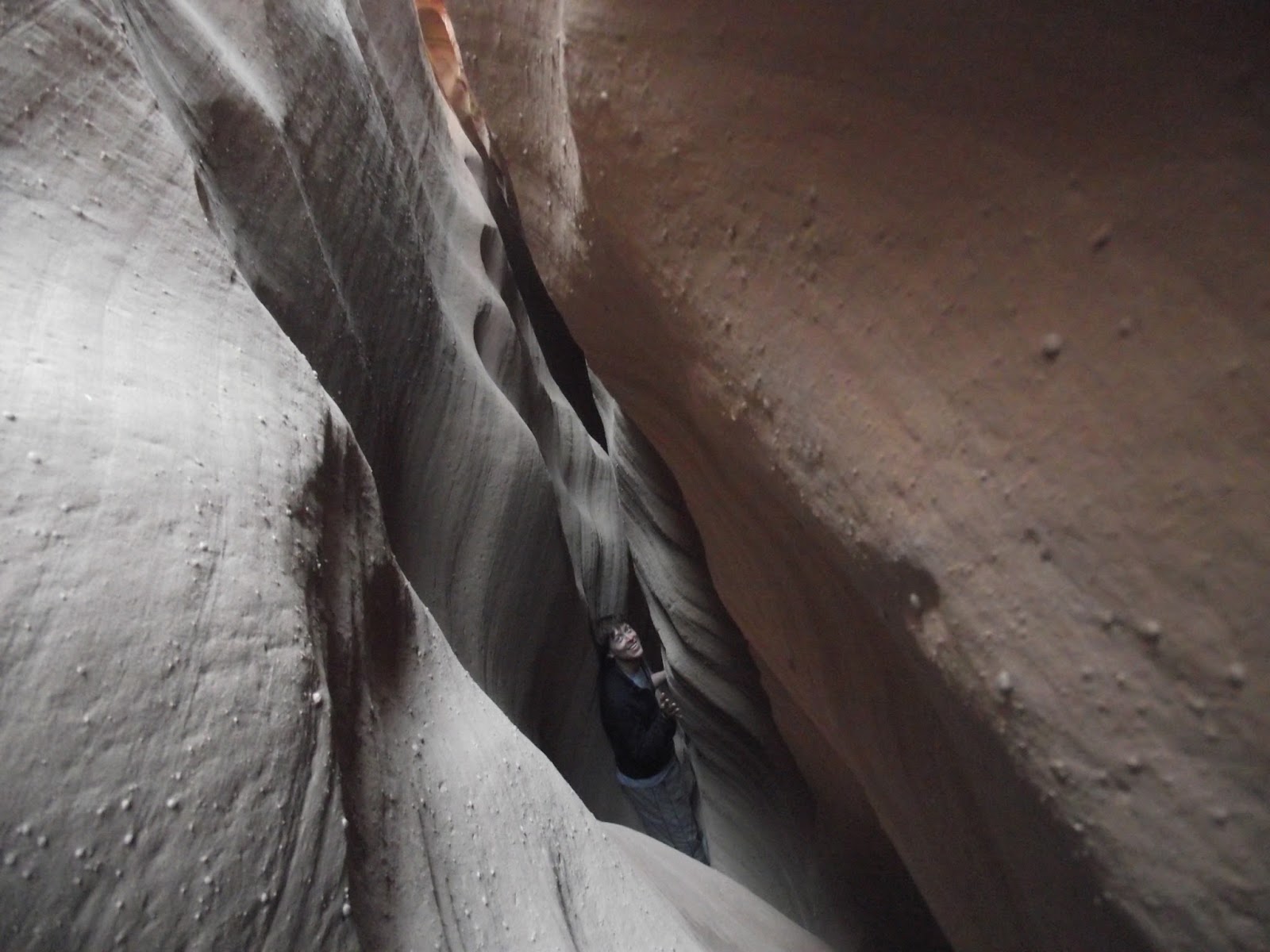
The walls of Chambers Canyon filtered out both heat and light. I was wedged deep inside its recesses, feeling the cool, smooth of the stone pressed on my hands and squeezed against my back. My legs strained to maintain steady pressure on my climbing shoes. Right then, those points of contact were the most important things in my life. If I let go, I would drop into the darkness.
A wanderer on the surface above might never suspect this great crack in the earth, not until he stumbled right up to (or into) it. Andrew and I, we sought it out. 
Now, I craned my head to the right where I could still see the light from the north end of the crevice that we had walked into. Still not too late to turn back?
Eventually, we would cross the point where it would be impossible or damn near it for us to turn around. At that point, our fates would be wedded to whatever challenges the canyon had in store for us.

To my left, Andrew scouted for the best route.
“It’s getting wider here, I don’t think we can keep going this way.”
“Well, where well the hell do we go then?” I asked, already dreading the answer.
If there was a way, it was beneath our shoes, in the place we couldn’t see, down there.
In a minute, Andrew was already working his way down into the crevice and was swallowed up inside the dark. I heard the friction of the canyon walls against his clothes, the occasional grunt as he worked against gravity to descend safely. How far until the bottom?
It would be possible in theory for him to climb back up the way he came, though much harder. The choices we made in the canyon wouldn’t be reversed easily. Maybe we couldn't reverse them at all. It was different from most hikes that I’ve taken where I’ve been comfortable with the idea that it wouldn’t be too hard to turn around.
Canyoneering seemed to cut a little closer to the real truth about the way of the world: that we are always crossing thresholds. Every decision has permanent consequences, some more than others. Once we cross those thresholds, the only thing we can do is accept the new reality, try to adapt and keep moving forward.

Claustrophobia anybody? This was one of the wider places in the canyon.

I stayed squeezed between the walls for a small lifetime, finally heard Andrew’s voice from below: he had made the canyon floor. Now it was my turn.
I started scuffling downward, working to maintain steady pressure as I felt my way along the knobs and indentations on the surfaces. In one instance, my legs would be fully extended and I kept my arms behind me. In another place, I held myself up with my knees. The friction of the sandstone ground and bit at me, on my hands, through my pants and jacket. Finally, Andrew came into view, and then I was able to put my feet down on the sandy floor. It was the first time I’d had my feet on anything like solid ground since we had started on the canyon about 20 minutes earlier.
Going down 
We began our descent about a mile from where we had parked the car. The journey began innocuously enough, a sandy path between chest-high walls of stone. The walls themselves formed a curious ripple pattern that I can only liken to carton drawings of ocean waves, only laid out horizontally. The stone moved in smooth arcs and then abruptly turned into a new direction. There were about 18 inches between the walls at the beginning, forcing us to move awkwardly between the curves. Gradually, the space between the walls began to tighten and the floor began to drop out from us.
We put our feet up on the walls and continued forward, getting higher and higher above the crevice, until eventually we both needed to climb down.

Back at the bottom, the walls closed out the sky. It was dark, but still light enough that we wouldn’t need a headlamp to navigate. There was the sandy path again, a road through the dimness we could follow to the next challenge. Here and there, a space would open up. There would be a sunlit alcove or some other place where ages of water on rock had carved out natural splendor.
Water. Even here in this dusty canyon, that ambitious liquid had left traces of its presence. Every now and then, I would make out a branch or a knot of desiccated vegetation on one of the walls overhead, reminding me that floodwaters had climbed that high. It probably hadn’t been that long ago either. 
No one had forecast rain on the day that we were going down, but if they had, it wasn’t difficult to imagine how screwed we would be. The narrow slot we were walking down was essentially an enormous storm drain for the acres and acres of surrounding hills. Because most of those hills were mostly stone, they would sluice all that water to our location trapping us like rats.
The thought of getting in such a maelstrom kept me on edge.
Suddenly, I heard the sound of liquid trickling over sand.
“What the fuck is that?”
“Just taking a leak here,” Andrew said from around the corner.

The water has shaped some interesting passages in the rock

One thing I noticed going through the canyon was how little life there was. The environment consisted of bare rock and bone dry sand with an occasional glance into the cloudless sky. At least it was cool here in the shade and that was a mercy. Eventually, the canyon walls widened and a hot strip of midday sun cut down into the center of the canyon. Soon we had to climb up again to where the water had carved the stone into a convex hollow, with the widest portion at about 6 feet across, that tapered at the top and bottom. I felt as though I was navigating an enormous sewer drain.
There were plenty of other places where the water had worn out immense chambers that were probably the reason that the place has the name Chambers Canyon. Distant light from above created a soft illumination on the red rock. The stone was pleasing to the eye, lit up in warm color and defined by sensuous curves.
At the same time, everything in those chambers was utterly lifeless, like a tomb. The places reminded me of the elaborate ballrooms in “The Masque of The Red Death” by Edgar Allen Poe. Those rooms, like the chambers that we walked through, were arranged so that no one walking down the main corridor would suspect that they existed until they came upon them. Similarly, the only way to see the rooms in the canyon is to enter, and the only way to enter is to clamber down through the walls.

Abstract art


 There were more narrow sections of the canyon up ahead. In order to go forward, I got familiar with using my butt as a means of transportation. I would keep steady pressure on my hands, back and climbing shoes and shift my butt by degrees in order to get a new hold on the walls. It was slow, but it was progress.
My jaw stayed clenched tight in these sections. A fall at that point wouldn’t have just meant injury, it also would have meant getting stuck deep, out of sight and miles from where anyone could hear screams for help.
A similar predicament had befallen a young adventurer by the name of Aron Ralston only 20 miles or so from this place. Most people are probably familiar with the story of how he got stuck in Blue John Canyon with a rock crushing his arm and only escaped because he cut off his trapped appendage with his pocketknife. I didn't have a pocketknife.
I was amused to read a National Geographic story later about some Aussie canyoneers who had taken to calling the dangerous rocks in canyons rall stones as a dark homage to the amputated outdoorsman.
There were a few rall stones in the canyon, including a few that fell into the canyon and got wedged between the walls. I tried not to put any weight on these, but sometimes it was hard to avoid.
I watched with some discomfort as the floor dropped further and further away, but the canyon walls were still too narrow for me to get there.

Beware the rall stone

The sight of a light in the canyon up ahead was just about the closest I’ve come to having a religious experience.
I scuttled eagerly toward the brightness like a green tendril seeking sun. I executed a couple of last tricky moves and then I was out.
Or was I?
Gradually, I became aware that I was still closed in by walls, that I had to scramble around a house-sized, boulder.
After that boulder, we found a 20-foot drop we had to go down by wedging our backs into the stone. When we got to the bottom, we found another narrow canyon section. I opted to wedge myself up higher where there was a wider passage. Andrew opted for the low road, which worked out for him until he got stuck and had to wrench himself out.
The narrow section moved on to another chamber and an up-climb.
We crawled out dazed, into the bright sun. We were still closed in by canyon walls, but now those walls were about 100-meters apart. The zone between was lush and green There were cottonwood trees with impossibly green leaves, cacti and sedges, all drawing water from the canyon drainage. The passage through the weird dark of the canyon made it all the more exhilarating to be in this place.
I thought back to all the tomblike stone behind me, beautiful but barren. And yet that crack through the desert was the reason for the life here. It was the Nile in the Sahara, enriching the plants and animals with water, filling the visitor with an appreciation for strange beauty. 


View from the last section of technical canyoneering

Sunday, June 9, 2013

The Arches


Two sides. Mighty. Locked in opposition. Brethren.
They meet each other in the air, bringing their immense weight together so that they are as one stone, an arch.
So it stands, and so it will stand for unknown ages above the desert.

Long before the Romans pieced their aqueducts together, the elements carved a series of arches in what is now Utah. Even as the stone and debris around these formations wore away, the arches remained, a series of unresolved arguments left standing because neither side would yield.
If one side conquered the other, both would crumble, shattering to so much rubble in the desert. The broken rock throughout Arches National Park is a testimony to one truth: all must fall, and even the immortal-seeming arches will not escape that inevitability. We certainly won’t.

Andrew going through a route

Dinosaurs left their footprints here. Now responsible human visitors must tread upon the maintained trails, or else limit their travel to the slick rock and washes where they won't disrupt the macrobiotic soil.
Amongst the massive stone landmarks, the soil holds life that can be crushed out by a single careless footstep. The grains of sand stay together because of a network of bacteria, fungi and algae — connections that can take as long as two centuries to build. That tiny, invisible cooperation makes it possible for trees and other plants to survive the desert.

Looking up at the enormous stone formations, I felt as puny as those microbes.  I was also exultant, exhilarated. The sight of the immense geologic forces told their own story, one that I was only a tiny part of.
I could try, clumsily, to understand the world sprawled out in front of me, but at its essence, the landscape had a meaning that had little to do with me. I was there to gape and pay homage to that immensity, to scramble antlike under sun and into the shadow of the red rocks.

The author trying out some canyon moves
Andrew and I took a path out to a series of arches then cut over to the slick rock. There were cracks in the stone, dark corridors where there was cool water, places to wedge our bodies between the walls and chimney-climb to secret chambers. We crawled in, took our pictures and crawled back out. The secret places in the rock were beautiful, but they were unnerving too and it was a relief to get back in the open air where there was no risk of falling off something or getting stuck between the rocks.
Far above our heads, the tallest stones in the park glowed in the late afternoon sunlight. It should be no surprise that we found ourselves climbing in that direction, just like moths headed toward the flame. 
We made our way by convoluted steps and random handholds in the stone. Every time we scrambled up to one prominence we expected to go no further. Then one of us would discover a convenient ledge and bring us that much closer to the goal.
After a final explosion of effort, it was all there: a desolated city, resplendent in the orange radiance of the sinking sun. The snowy peaks of the La Sale mountains were in the east.
We took a moment to hold in that majesty, but then there are some things that are so beautiful, magnificent and strange that you can never really hold them in. Finally, we turned back the way we came and scrambled down the slick rock to the trail.
We started running, sucked the dry air into our lungs, chased our shadows through the stone hallways,  abandoning the monuments to the dark and to the millions of years of crumble yet to come.


Thursday, June 6, 2013

Barons of Backcountry

Andrew climbing up from Little Cottonwood Canyon
      The backcountry skiers were already packing up their cars by the time we got to the parking lot, going home from trips they had started in the wee hours. They had taken advantage of the best snow the day would have to offer. 
As for Andrew and I, we would need to climb fast if we wanted to climb to the top of anything important and get down before the sun went down and the snow froze up.
The 11,000-foot summits towered snowy-white above Little Cottonwood Creek, a skier’s paradise of alabaster ridges and monster-sized bowls, festooned with fearsome outcrops of exposed stone. Further down, the tundra gave way to lodgepole pines that shaded the snow from the late April sun.
What sun! It was hot enough that I started up the trail in a T-shirt with naught but a T-shirt and snowpants. Even so, I was dripping sweat within the first set of switchbacks. I kept taking my ski goggles off and on — off when the goggles fogged up under my exertions and on again when the bright light coming off the snow stabbed my eyes. I had the ski skins and Andrew was going up on snowshoes. We still hadn’t decided which peak that we would climb.
After about two hours of climbing we came out of the trees and had a view of the high peaks, two thousand more feet of snow and rock.
We opted for a peak to the northwest of us and then began a lung-busting climb for the summit. Once again, I found myself doing switchbacks following another route laid by a skier who had gone before. I gained a couple hundred feet on the switchbacks, getting closer to a steep section between canyon walls that were not unlike the canyon gullies we had gone down around Snowbird the other day.
As I climbed, I became aware of two things: the pitch was getting steeper and the snow was getting harder. I found myself using the left edge of my skis more and more in order to cling to the mountain. Up ahead, there was a small flat area beneath a rock face that might have offered a place for me to turn the skis around and start a new line.
But how was I going to get there without flopping over in a big-ass tumble? Round and round and round I’d go and where I’d stop nobody’d know.
I stomped down desperately against the snow crust, struggling for even a feeble purchase. I did not feel secure at all. It occurred to me that the ski boots would have much better purchase if they weren’t attached to the skis beneath them. I reached down, snapped the skis off and stepped into the knee-deep snow. It would be slower going, but now I didn’t have to worry about falling.
Meanwhile, the last traverse had taken me about two football-field lengths from where Andrew was climbing. Getting back to the main route required that I plunge my poles and then the skis into the crust, again and again. Pretty exhausting work. I figured I could just leave the skis and continue on to the summit without them. But Andrew was pretty sure he could get get up the mountain using my skis as poles.
“Are you sure,” I asked, mindful of the fact that if he carried them to the top, I would probably end up sking down the gnarliest part of the mountain.
Andrew clipped them to the pack and started over a boulder pile. I stumbled after in the heavy ski boots, looking for hand holds in the rock or punching my gloves through the crust in order to grip the snow. After a few more boulder wriggles and kick steps, we reached the place where we could go no higher without going down again. In front of us, lay another  — miles of snow, more peaks towering higher yet than the place where we stood.
I was still in my T-shirt, now I reached into my pack for a windbreaker and parka, preparing for the descent.
Andrew took the lead again, and I started with a couple swerves, on the gentle incline near the summit. I stopped at the top of the steep part and began a slow sideways skid on the iciest part of the snow and came to a second halt.
I was sick of fighting gravity. I pointed the skis down and went through a turn without falling. The second one dropped me and I went tumbling (glad I brought  the helmet) and then stopped. It took a couple of falls to make it out of the gully, and then it was just your basic skiing on a big, clear slope.
We reversed an hour of climbing in just a couple of minutes, then got into some tricky crust. Fortunately, the snow was softer by the time we got back into the trees. We pushed through a flat section of woods and then we flew back down through the forest getting down to the trailhead before the sinking sun cooled the warm snow back into ice.

The author standing on a Wasatch summit